Teacher education remains a cornerstone of national development, and in Ghana, several public universities continue to provide accessible and structured pathways for training professional educators. As prospective students and stakeholders prepare for the 2025/2026 academic year, understanding the fee structures across institutions is essential for informed decision-making. This article presents a comparative overview of tuition fees for education programmes in selected Ghanaian universities.
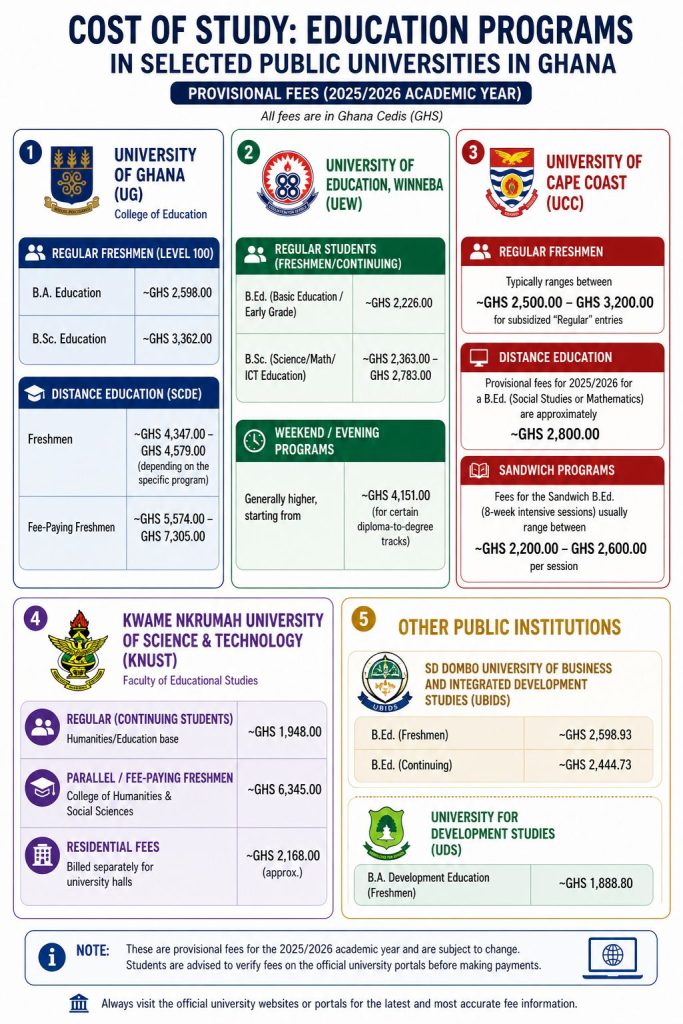
University of Ghana (UG) – College of Education
The University of Ghana operates a collegiate system, with education programmes housed under its College of Education. For regular freshmen (Level 100), fees are relatively moderate:
- B.A. Education: Approximately GHS 2,598.00
- B.Sc. Education: Approximately GHS 3,362.00
Distance education, offered through the School of Continuing and Distance Education (SCDE), attracts higher fees due to its flexible structure:
- Freshmen: Between GHS 4,347.00 and GHS 4,579.00
- Fee-Paying Freshmen: Between GHS 5,574.00 and GHS 7,305.00
These options cater to both traditional and non-traditional learners seeking flexibility.
University of Education, Winneba (UEW)
As Ghana’s premier teacher-training institution, UEW offers a wide range of specialized education programmes. Its fees are structured according to faculty and programme type:
- B.Ed. (Basic Education / Early Grade): Approximately GHS 2,226.00
- B.Sc. Education (Science/Math/ICT): Between GHS 2,363.00 and GHS 2,783.00
For non-regular pathways:
- Weekend/Evening Programmes: Starting from GHS 4,151.00, especially for diploma-to-degree transitions
UEW remains a cost-effective option for students focused on professional teaching careers.
University of Cape Coast (UCC)
Recognized as a leading institution for education in West Africa, UCC maintains competitive fees:
- Regular Freshmen: Typically between GHS 2,500.00 and GHS 3,200.00
Alternative study modes include:
- Distance Education (B.Ed.): Approximately GHS 4,000.00
- Sandwich Programmes: Between GHS 3,200.00 and GHS 4,600.00 per session
These flexible options make UCC attractive to both full-time students and working professionals.
Kwame Nkrumah University of Science and Technology (KNUST)
KNUST offers education programmes through its Faculty of Educational Studies, combining academic rigor with practical training:
- Regular Continuing Students: Approximately GHS 2,948.00
- Parallel/Fee-Paying Freshmen: Around GHS 6,345.00
In addition, students should note:
- Residential Fees: Approximately GHS 2,168.00 for university halls, billed separately
KNUST’s fee-paying options provide access for students who may not gain admission through the regular stream.
University of Business and Integrated Development Studies (UBIDS)
UBIDS continues to expand its education programmes with competitive pricing:
- B.Ed. (Freshmen): Approximately GHS 2,598.93
- B.Ed. (Continuing): Approximately GHS 2,444.73
Its affordability makes it an appealing option for students in northern Ghana and beyond.
University for Development Studies (UDS)
UDS offers a unique programme in development education:
- B.A. Development Education (Freshmen): Approximately GHS 2,888.80
This programme integrates education with community development, preparing graduates for diverse roles in education and social intervention.
Conclusion
The cost of pursuing teacher education in Ghana varies depending on the institution, programme type, and mode of study. Regular programmes across most public universities remain relatively affordable, generally ranging between GHS 2,200.00 and GHS 3,300.00. However, alternative pathways such as distance, weekend, and fee-paying programmes can significantly increase costs.
Prospective students are encouraged to consider not only tuition fees but also additional expenses such as accommodation, learning materials, and transportation. Ultimately, the choice of institution should align with one’s academic goals, financial capacity, and preferred mode of study.
As Ghana continues to invest in quality education, these institutions remain pivotal in shaping the next generation of teachers and educational leaders.
#MOH #UEW #UCC #KNUST #UBIDS